


Botany, Tree Research & Agroforestry
Fauna Forever's botany and forest science research program and Agroforestry project. Video: Foggy Lens Productions
Gain practical experience in tropical ecology, agroforestry, and applied field research in the Peruvian Amazon.This combined Tree Science and Agroforestry programme offers a broad, hands-on introduction to how forest ecosystems and sustainable production systems are studied and managed in real-world contexts.Working alongside our research team, you will contribute to a diverse range of activities, including establishing and monitoring agroforestry plots, collecting seeds, producing plants in nurseries, and supporting field-based data collection. You will also engage with local farmers and community initiatives, gaining insight into the social and environmental dimensions of land use in the Amazon.The programme is highly field-based, with most days spent outdoors developing practical skills, building ecological knowledge, and contributing to ongoing research projects. It is designed for those looking to gain meaningful experience in tropical fieldwork while exploring the intersection of conservation, sustainable agriculture, and community collaboration.
Tree Science Team
Objectives
The tree research team, with headquarters in the city of Puerto Maldonado, studies the incredible diversity of trees, palms and lianas that shape the forest and support its wildlife. By establishing permanent research plots, we measure diversity, forest composition, tree abundance, dominance, structure, and carbon storage. The information we generate becomes the foundation for all other wildlife research at WIPERU, helping teams studying mammals, birds, amphibians, and many other groups understand how their species interact with the forest.
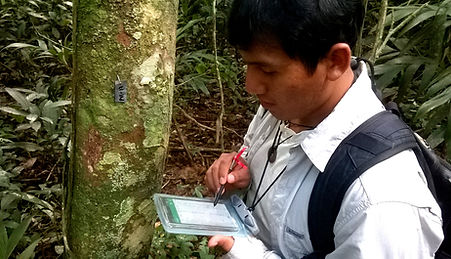
Research coordinator, Darwin Solano, inputting tree data directly into the smartphone. Photo: Chris Kirkby
%20small_JP.jpg)
The internode area of a Guadua sarcocarpa bamboo stem. Photo: Chris Kirkby
Methods Used and Skills Taught
As a volunteer or intern, you will be immersed in hands-on botanical research from the first day. You will learn how to establish and measure forest plots through methodology RAINFOR (1 hectare plot size), take diameter breast height (DBH) measurements, height estimates and other dasometric information, use GPS to georeference trees and plot corners, and identify Amazonian species using field characteristics, photographs, and via the collection and preservation of botanical samples. In addition, you will be introduced to data analysis techniques, including carbon calculations and the use of software tools such as R and QGIS. You will work with iconic and ecologically important tree genera such as Bertholletia, Dipteryx, Cedrelinga, and Ceiba, and you will also explore the understory to understand the ecological and medicinal roles of smaller plants. Throughout the experience, you will learn to read the forest using all your senses, observing textures, scents, structure, and ecological patterns that reveal the identity of each tree.
%20(2).jpg)
Tree research team intern, Pedro (from Colombia), identifying a tree species by looking at leaf venation. Photo: Nicholas Cade
.jpg)
The gloom at the base of a giant Fig tree, festooned with lianas.
Photo: Juan Carlos Huayllapuma

Ceiba tree towering over the forest floor. Photo: Chris Kirkby
A Typical Day
Research days begin early at 7:00 a.m. with the team having breakfast together. Our fieldwork usually consists of three main activities. Depending on the objectives of the day, we may focus on just one activity or combine all three. Since we remain in the field until around 3:00 p.m., everybody should bring a box lunch (prepared by our chef) and sufficient water to drink (2 litres).
1. Establishing Permanent 1-ha Plots
We start by walking along forest trails to a previously selected site where a 100 m × 100 m (1 ha) permanent plot is to be established or has already been established. If the plot is not yet established, we will measure and mark its boundaries and record the four corners as precisely as possible using high-precision GPS unit (EMLID). Inside the main plot, we establish 25 subplots (20 m × 20 m) using measuring tapes and rope.
2. Tree measurements and data collection
Within each subplot, we measure all trees with a diameter at breast height (DBH) of at least 10 cm. For each tree, we record:
-
Diameter (DBH)
-
Total height
-
Crown illumination
-
Presence of lianas
-
Phenological status (flowers, fruits, new leaves)
-
Other ecological observations
Each tree is tagged with a numbered aluminium label and marked with red paint at the measurement point.
3. Botanical Sampling
When necessary, we collect botanical samples for identification. A terminal branch from each unidentified species is carefully cut. Samples are pressed, labelled, and preserved in alcohol before being transported to the herbarium. All activities are supervised by the team coordinator, and schedules may change depending on weather conditions or research priorities.
Small plots of 0.05 ha:
Research days are split into morning and afternoon sessions. On most morning sessions, sampling begins at 8:00 am, after breakfast, with assessing the map of forest types at the field site and identifying the two or three plots that will be sampled or remeasured that day. After navigating to the location using a GPS unit, the team will establish or remeasure a 0.05 ha (10 x 50 m) plot, before measuring and identifying every tree with a DBH of at least 10 centimeters. Photographs are taken to support identification, and botanical samples are collected when needed. In the afternoon, usually one more plot is sampled before returning to the station to input data into the computer, review identifications, and discuss questions or unusual species encountered during the day. All research schedules and activities are subject to change at the discretion of the team coordinator.
Potential Thesis Questions that could be answered with our help
-
How does natural regeneration in the understory vary in structure, composition, and taxonomic diversity across forest types in Amazonian Peru?
-
How does necromass differ among forest types in Amazonian Peru, as measured by standing dead trees, fallen trunks, and thick woody branches on the ground?
-
How do plant functional traits differ among disturbed forest types in Amazonian Peru, and how do these differences shape functional composition?
-
How are vegetative and reproductive phenophases of key Amazonian timber and non-timber species related to climatic variability, and how can these patterns inform seed tree selection and sustainable forest management?
-
How does the growth rate of different tree species vary between forest types with varying levels of moisture and nutrient content?
Agroforestry Team
Objectives
The Agroforestry Team, based at the Secret Forest Research Station (SFO), works on the design, implementation, and monitoring of agroforestry systems that integrate sustainable production, ecological restoration, and biodiversity conservation in the Peruvian Amazon.
Our objective is to develop resilient production models that combine native forest species with agricultural crops, contributing to the restoration of degraded landscapes and strengthening sustainable livelihoods for local communities. Through the establishment of agroforestry plots, restoration initiatives, and reforestation activities, the team evaluates plant survival and growth, interactions between trees and crops, and the potential for carbon capture and storage in mixed-species productive landscapes.
The team also maintains close collaboration with local farmers and cooperatives, providing technical training in agroforestry practices, productive restoration, and sustainable land management. In addition, the team actively participates in environmental education activities, promoting awareness about the importance of forest conservation and the sustainable use of natural resources among local communities, students, and visitors.
Methods Used and Skills Taught
As a volunteer or intern, you will participate directly in practical agroforestry and restoration activities from the first day. During your stay, you will learn how to establish agroforestry plots, plant and manage native and productive species of plants (fruit trees, timber trees, annual crop plants), and support restoration initiatives in degraded areas or areas impacted by human activities.
You will also gain experience in seed collection in the forest, identifying seed trees and collecting seeds from native species that are later used to produce plants for nurseries and restoration projects. Another key component of the program is tree nursery work, where you will learn how to prepare substrates, fill nursery bags, transplant seedlings, and maintain native plants until they are ready to be planted in the field.
Field activities also include visits to local farmers, where the team collaborates with producers, exchanges technical knowledge, and learns about local agroforestry management experiences. Some of these visits may be overnight visits spanning several days. Volunteers may also support environmental education activities, participating in awareness initiatives related to Amazon forest conservation and sustainable land use.
During fieldwork, participants interact with important agroforestry species such as Theobroma cacao, Inga edulis, Bactris gasipaes, Dipteryx ferrea, and Bertholletia excelsa, as well as several native forest species commonly used in ecological restoration.
Since most activities take place outdoors under tropical forest conditions, the work often involves long walks, transporting plants and materials, digging planting holes, and working in hot and humid conditions. For this reason, participating in the agroforestry team requires good physical condition, a willingness to work in the field and getting dirty at times, and the ability to respect local cultures and practices.
A Typical Day
Workdays begin early, at 7:00 a.m. with the team having breakfast together. Field activities vary depending on project needs but generally include establishing agroforestry plots, nursery work, restoration activities, or seed collection trips. Since the team remains in the field for most of the day, all participants should bring sufficient water and sometimes a box lunch.
1. Establishment of Agroforestry Plots
The team travels to designated sites where agroforestry systems or demonstration plots are being implemented. Activities generally include:
-
Plot delimitation and layout of planting lines
-
Digging planting holes
-
Planting native forest species as well as annual and perennial agricultural crops
-
Application of organic substrates or soil amendments
-
Recording the location, number, and survival of planted individuals
These activities often require considerable physical effort due to manual work and the transportation of plants and tools in the field.
2. Nursery Work and Plant Production
Some days are dedicated to tree nursery work, where native plants are produced for restoration and agroforestry projects. Activities include:
-
Preparation of nursery substrates
-
Filling planting bags
-
Transplanting or pricking out seedlings
-
Watering and maintaining plants
-
Selecting plants suitable for field planting
These activities are essential to ensure the availability of healthy seedlings for restoration and agroforestry initiatives.
3. Seed Collection and Forest Walks
The team also conducts field trips to collect seeds from native forest species. During these activities, volunteers learn how to identify seed trees, recognize reproductive stages, and apply basic seed collection techniques used in forest restoration programs.
4. Reforestation and Restoration
Another important component of the work is the reforestation of degraded areas or areas impacted by human activities. During these activities, native species are planted to help restore forest structure, improve soil conditions, and support biodiversity recovery.
5. Work with Local Farmers and Environmental Education
On certain days, the team visits local farmer associations to support agroforestry initiatives, monitor demonstration plots, and participate in training activities for producers.
The team also contributes to environmental education programs, supporting awareness activities aimed at strengthening understanding of forest conservation, ecological restoration, and sustainable land use in the Amazon.
Potential Thesis Questions that could be answered with our help
-
How do plant survival and growth vary among different agroforestry system designs in the Peruvian Amazon?
-
What is the potential of agroforestry systems to restore degraded landscapes and improve soil fertility in the Amazon?
-
Which native forest species show the highest survival and growth rates in reforestation projects in areas degraded by human activities?
-
How do seed origin and nursery management influence the performance of seedlings used in restoration programs?
-
How do agroforestry training programs influence soil management practices among local farmer associations?
Recommended Reading
Field Guides

Published Articles
Williams (2001) Review of antiviral and immunomodulating properties of plants of the Peruvian rainforest with a particular emphasis on Una de Gato and Sangre de Grado. Alternative Medicine Review 6(6): 567.
Vandebroek (2004) A comparison of traditional healers' medicinal plant knowledge in the Bolivian Andes and Amazon. Social Science & Medicine 59: 837–849.
Balunas (2005) Drug discovery from medicinal plants. Life Sciences 78: 431-441.
Bussmann (2006) Traditional medicinal plant use in Northern Peru: tracking two thousand years of healing culture. Journal of Ethnobiology and Ethnomedicine 2.
Bussmann (2007) Blending traditional and Western medicine: medicinal plant use among patients at Clinica Anticona in El Porvenir, Peru. Ethnobotany Research and Applications 5.
Perrault-Archambault (2008) Distribution of agrobiodiversity in home gardens along the Corrientes River, Peruvian Amazon. Economic Botany 62(2): 109–126.
Sanz-Biset (2009) A first survey on the medicinal plants of the Chazuta valley (Peruvian Amazon). Journal of Ethnopharmacology 122: 333–362.
Trees of Peru. By: TD Pennington


